Cartography of Nightmares: AI-Generated Maps and Visual Worldbuilding
Open any beloved fantasy novel and chances are you’ll find a map before the first chapter. Readers flip to it constantly. They trace character journeys with their fingers. They study the blank spaces at the edges and wonder what lives there. Maps transform worlds from concepts into places.
Dark fiction needs maps differently than other fantasy. In epic fantasy, maps promise adventure. Wide horizons, distant kingdoms, trade routes and mountain passes that suggest possibility. In dark fiction, maps promise threat. The territory between safe points becomes a landscape of dread. The empty regions aren’t invitations. They’re warnings. And the places clearly marked on the map are often worse than the unknown because someone went there, named what they found, and the name itself implies something terrible.
AI image generation has made cartography accessible to writers who can’t draw a straight line. But accessible doesn’t mean easy. Generating a map that actually serves your story, that communicates geography and atmosphere and narrative function simultaneously, requires the same intentional craft as any other element of your worldbuilding.
Why Maps Matter for Dark Fiction
Maps anchor the reader’s spatial imagination. Without one, readers construct their own mental geography, and those constructions rarely match the author’s intent. Character A travels east for three days, but the reader pictured them going north. The mountain range that looms over the protagonist’s hometown exists only vaguely in the reader’s mind, a concept rather than a presence.
In dark fiction, spatial disorientation can be either a tool or a failure, and maps help you choose which. When you want readers to share the protagonist’s confusion, withhold the map. When you want readers to know something the protagonist doesn’t, the map showing that the road leads directly toward the marked danger zone, the visual creates dramatic irony that prose alone handles clumsily.
Maps also solve continuity problems that plague dark fiction worldbuilding. The distances between locations. The travel times. The logical question of why characters don’t simply go around the haunted forest instead of through it. A map that shows the forest extending unbroken for three hundred miles east and west answers that question visually, without a single line of exposition.
The geography of dread operates through maps in ways unique to the genre. The cluster of settlements that thins as you approach a particular region. The roads that exist everywhere except near one specific location. The river that flows from unknown sources in the mountains. These geographic patterns tell stories about what inhabitants fear, what they avoid, where the world’s malice concentrates. A reader who studies the map absorbs this information intuitively, building atmospheric understanding before the prose begins.
AI Cartography: Tools and Approaches
Current AI image generators produce fantasy maps with varying degrees of success. The key is understanding what each tool does well and structuring your prompts to exploit those strengths.
For overall map generation, detailed prompts that specify style matter more than geographic detail:
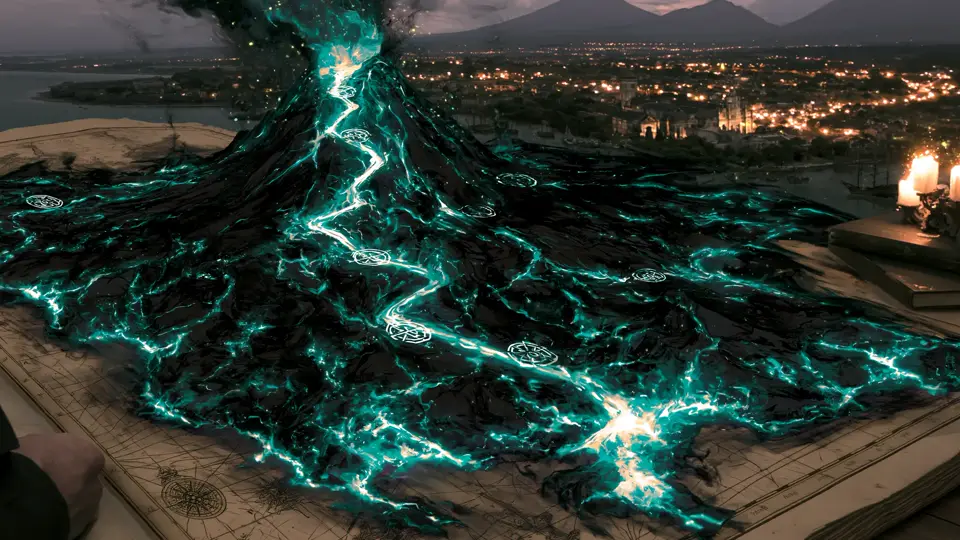
“An aged parchment fantasy map in the style of hand-drawn medieval cartography. Dark ink on yellowed vellum. A coastal region with a mountainous interior, dense forests along the western coast, a river system flowing southeast to a delta. Small settlement markers cluster along the coast and river, but the mountain interior is empty except for a single symbol at the center marked with warning iconography. Decorative border with gothic elements. Sea serpent illustrations in the ocean. Compass rose in the corner. No text or labels.”
The “no text or labels” instruction is critical. AI-generated text on maps is almost always garbled, misspelled, or nonsensical. Generate the visual geography first, then add text using image editing software. This two-step process produces dramatically better results than asking AI to handle both elements simultaneously.
Style specification prevents the most common failure mode: maps that look like satellite photographs or modern digital renderings rather than artifacts that could exist within your world. Reference specific cartographic traditions. Medieval European portolan charts. Chinese scroll maps. Victorian-era expedition cartography. Each tradition carries distinct atmospheric associations that color how readers perceive the world.
“Generate a dark fantasy map in the visual style of 17th-century Dutch maritime cartography. The map should feel like it was drawn by an explorer who found something they wished they hadn’t. Include deliberate areas of incompleteness where the cartographer stopped mapping, as if they turned back. The edges of the explored region should feel ragged and uncertain, not clean borders.”
That prompt creates a map that tells a story before a single word of fiction appears. The incomplete edges. The cartographer who turned back. The visual narrative of a world that resists being known. This is cartography as atmosphere.
Faction Territory Visualization
Dark fiction worlds with multiple competing factions benefit enormously from territorial maps. These visualizations solve organizational problems for the writer and create immediate political comprehension for the reader.
Generate base maps and then create overlay variants showing faction control:
“Using the same geographic base, create three variants: one showing the current territorial control of three factions using distinct visual styles (not colors, since parchment maps don’t use color fills). Faction A controls through dense settlement markers and road networks. Faction B’s territory is marked by fortress symbols and wall lines. Faction C’s influence is shown through religious site markers and pilgrimage routes. Contested regions between factions should show overlapping markers and visual tension.”
The instruction to avoid color fills is practical. Most readers encounter maps in black-and-white print or e-reader displays. Territorial distinctions that rely on color fail in these formats. Visual pattern differentiation, different marker types, line styles, density variations, works across all display contexts.
Temporal faction maps create visual narrative. The same territory mapped at three different points in your story’s timeline shows expansion, contraction, and collapse through changing territorial boundaries. These temporal maps are invaluable planning tools that also function as compelling supplementary content for readers invested in your world’s political complexity.
“Create a sequence of three maps showing the same region across three time periods. Period one: three roughly equal territories with clear borders. Period two: one territory has expanded significantly, consuming a third of another. Period three: the expanded territory has fragmented into smaller splinter regions while the previously diminished territory has reasserted itself from a different center of power. Each map should feel like it was drawn during that period, reflecting the cartographer’s likely allegiance through subtle visual bias.”
That final instruction, the cartographer’s allegiance, adds a layer of unreliable narration to the maps themselves. An in-world map wouldn’t be neutral. The cartographer would be from somewhere, serving someone, and their biases would shape what they emphasized, minimized, or omitted entirely. This kind of detail transforms a functional tool into a worldbuilding artifact.
The Geography of Dread
Landscape shapes atmosphere. This principle operates in prose, but it operates in maps with a different and complementary power. Prose describes what a landscape feels like to traverse. Maps show the landscape’s shape, its logic, the patterns that emerge when you see the whole rather than the character’s limited ground-level perspective.
Certain geographic patterns generate dread inherently. The valley with a single exit. The island with no harbor. The settlement positioned at a crossroads with roads leading to marked dangers in every direction, meaning every approach brings travelers past something terrible. These patterns communicate threat through spatial logic.
Design your dark fiction geography with atmospheric intent:
“Design the geography of a region that should feel subtly wrong to anyone studying the map. The river system doesn’t follow natural drainage patterns. The settlements are positioned at distances that suggest people moved as far as they could from a central point and stopped only when they couldn’t go farther. The elevation changes don’t correspond to normal geological processes. The map should look plausible on first glance but increasingly unsettling on closer examination.”
This approach treats geography itself as a horror element. The landscape carries the imprint of whatever dark force operates in your world. Readers who study the map closely discover what casual observers miss: the world itself is shaped by something unnatural. This creates a layered experience where the map rewards attention in the same way the prose does.
Verticality matters and is underrepresented in fantasy maps. A cross-section view showing the depths beneath a location, the underground rivers, the cave systems, the buried structures, communicates threat that flat maps cannot. The surface world might look manageable. The cross-section reveals what waits beneath.
Visual Lore Supplements
Maps are the entry point to a broader category of visual worldbuilding: artifacts that exist within your world and can be presented to readers as found objects.
Bestiary pages showing creatures from your world, rendered as if drawn by an in-world naturalist. Architectural diagrams of significant structures. Heraldic designs for factions and families. Botanical illustrations of magical flora. Each of these visual supplements adds a sensory dimension to worldbuilding that prose alone can’t achieve.
“Create a page from an in-world bestiary depicting [creature name]. The style should be a detailed naturalist illustration with anatomical annotations, as if drawn by a scholar who studied a dead specimen. Include margin notes in the style of handwritten academic observations. The illustration should be scientifically precise but the subject should be deeply unsettling, creating tension between the clinical presentation and the horrifying subject.”
The tension between clinical presentation and horrifying subject is where this technique gains its power. A monster described in prose is the author’s creation. A monster presented as a scientific illustration implies a world where someone studied it, classified it, wrote careful notes about its anatomy. That world feels more real, and more dangerous, than a world where monsters simply appear and threaten.
These visual artifacts also create marketing assets. A bestiary page shared on social media generates engagement that text excerpts rarely match. A faction heraldic design becomes recognizable iconography that readers associate with your world. A map fragment shared as a teaser before publication gives readers a tangible piece of your world to examine and discuss.
Consistency Across a Series
Series worldbuilding demands visual consistency. The map in book one establishes geography that every subsequent book must respect. AI-generated maps create a particular challenge here: reproducing the exact same style, geography, and level of detail across multiple generation sessions.
The solution is establishing a master map early and generating subsequent maps as modifications rather than independent creations:
Start with the most complete version of your world’s geography. Generate this master map with maximum detail. Save it at the highest resolution available. This becomes your canonical reference, the source of truth that all subsequent maps must align with.
For subsequent books, use image editing to modify the master rather than regenerating from scratch. New regions can be added to the edges. Political boundaries can shift. Newly discovered features can appear. But the core geography remains stable because it’s the same base image.
“I need to extend this existing map northward to reveal a previously unmapped region. The new territory should feel like a natural geographic continuation: mountain ranges that connect to existing ranges, river systems that flow from the new territory into previously mapped rivers, coastline that follows the established continental shape. The artistic style must match the existing map exactly. The new region should feel more dangerous and less known, with sparser detail and more blank space.”
When perfect style matching proves impossible, and with current AI tools it sometimes does, lean into the inconsistency as a worldbuilding feature. The northern territories were mapped by a different cartographer, from a different culture, using different conventions. The stylistic shift becomes an in-world detail rather than a production error.
Track your visual worldbuilding decisions with the same rigor you apply to prose continuity. The mountain range’s shape. The river’s exact path. The relative positions of settlements. These details become canon the moment readers see them, and contradictions between your maps and your prose will be noticed, cataloged, and discussed on forums for years.
From Map to Manuscript
The final purpose of visual worldbuilding is improving the prose it supports. Maps don’t replace written worldbuilding. They refine it.
Write a scene. Consult your map. Discover that the character standing on the eastern wall would actually see the mountains to their left, not behind them. Realize that the river the character crossed in the morning would still be audible from the hilltop where they camp. Notice that two locations described as distant are actually separated by a day’s walk.
These corrections matter because spatial accuracy creates the texture of a real place. Readers who’ve studied your map will catch errors. But even readers who haven’t studied it will sense the difference between geography that functions consistently and geography that shifts to suit the scene.
Maps also generate scenes you wouldn’t have written otherwise. That narrow pass between two mountain ranges becomes a natural chokepoint for an ambush. The river island becomes a defensible position. The settlement positioned at the edge of the empty zone becomes a frontier town with all the atmosphere that implies. Geography suggests narrative, and visual geography suggests it more immediately than abstract spatial concepts.
Your dark fiction world exists as a web of words. Maps give that web a shape readers can hold, study, and return to. They transform abstract geography into tangible place. And in dark fiction, where atmosphere depends on the reader’s spatial imagination, a well-crafted map does what a thousand words of description attempt: it makes the world feel real enough to fear.
Chart your nightmares. Let readers navigate them. And leave enough blank space on the edges to remind them that the mapped world is only the territory someone survived long enough to record.