Three Names on One Door: Retitling a Trilogy After It Shipped
For most of its life the flagship game of this project was called Faviana, because that is who you play and naming files after your protagonist is what you do at two in the morning. Then the trilogy became real. Three games, one landing page, a Steam plan, and suddenly the names had to stand next to each other like products, and products expose each other’s weaknesses the way siblings do.
Put FAVIANA beside THREE FLAGS and COURTESANA and read the row aloud. One of these is a woman’s first name, which reads like a dating sim or a biography. Two of them start with the same four letters, which your eye catches instantly once someone points at it and never stops catching after. And only one of them, COURTESANA, actually behaves like a title: a place, a role, a promise, a word you can own in a search box.
What a Title Owes You
A game title has three jobs my working names were not doing. It has to be ownable, meaning a search for it finds you and not a hundred other things. It has to be evocative of the fantasy rather than the file structure. And inside a franchise it has to harmonize with its siblings without rhyming into mush.
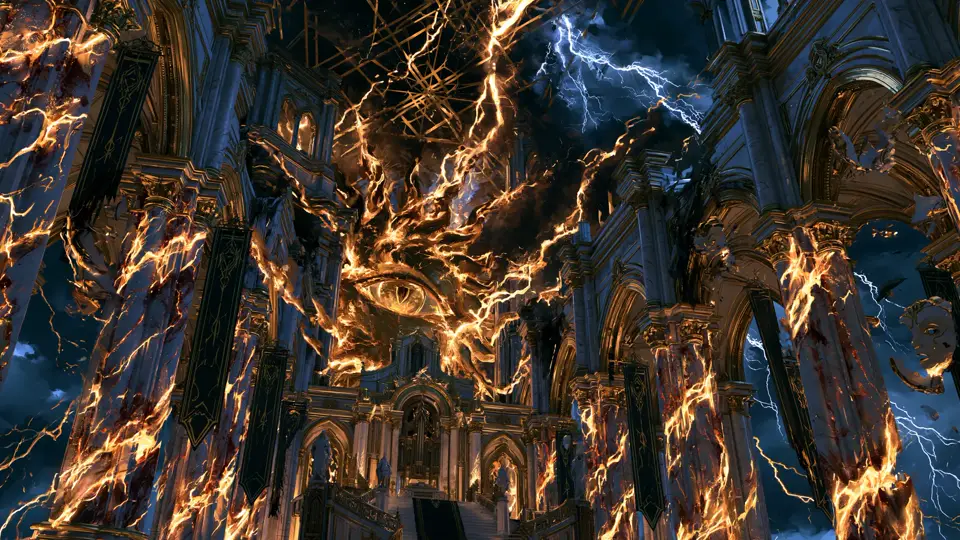
The flagship became THREADWALKER, and the moment it did, a joke that had been sitting on the masthead for months became lore. The landing page has always said The Guild of Threadwalkers Presents, a bit of publisher theater. Now the flagship is the guild’s own trade: Faviana is a threadwalker, walking threads between worlds is what the whole saga is about, and the eventual endgame that connects every game had a naming grammar waiting for it before a line of it exists. Her name did not vanish. It moved into the kicker, FAVIANA’S ELDRITCH DESCENT, where a person’s name belongs: above the title, possessive, human.
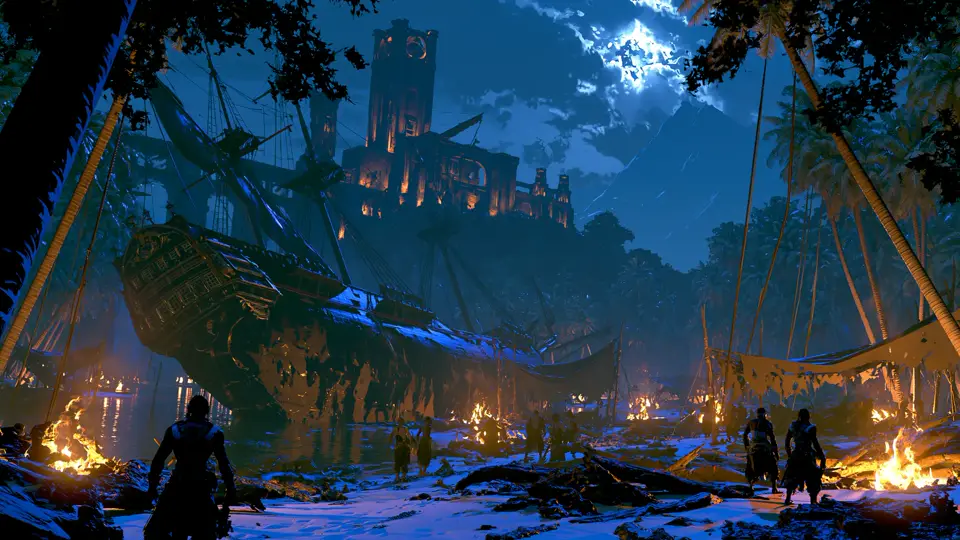
The pirate game had a harder problem, because THREE FLAGS was a decent name that had simply been standing in the wrong spot when THREADWALKER arrived. Thre and Thre in one row is a typography accident forever. The fix came from the game’s own language: TRES BANDERAS. Same meaning, same flags, Gloria’s own tongue, and suddenly the row read as three distinct silhouettes, one English compound, one Spanish phrase, one Italianate noun, each heroine’s kicker above her title in the same possessive grammar. GLORIA’S FIRST VOYAGE. ESMERALDA’S NIGHT AT THE CASTLE. The system does the branding work a logo studio would charge five figures for, and it fell out of two renames.
The Triptych, or the Pixel Politics of Faces
The other half of this era was the landing page itself. Three games deserve better than three rectangles in a row, and the owner of this project had a sharper idea: split the hero band into a triangle triptych, the flagship as an inverted keystone in the center, the other two doors leaning in from the sides. It looks inevitable in hindsight, which is the highest compliment a layout gets.
What nobody tells you about diagonal frames is that every crop becomes a negotiation with a face. A wedge is widest at one end and vanishes at the other, and CSS background sizing gives you exactly zero slack to reposition an image once cover fits it to the container on the long axis. Gloria kept losing her head to the diagonal until we stopped asking cover for permission entirely: zoom the art past the frame, mint slack on purpose, then place her eyes where the wedge is widest. Esmeralda arrived later as a portrait, taller than her wedge is wide, and needed the opposite trick, sized by height, anchored to the outer edge, with the empty sliver behind her shoulder falling to darkness like a stage wing. Faviana holds the keystone with her face in the widest band and the summon button at her waist, after one embarrassing build where the button sat directly across her eyes like a censor bar.
The lesson generalizes past this page. When art and layout fight, the layout is lying about being neutral. Every frame has a place where a face survives and places where it dies, and the frame was chosen before the face arrived. Do the arithmetic for the face.
Rename Early, or Rename Honestly
I will not pretend the timing was ideal. The right week to name a game is before anyone plays it. But the second-best week is the one where you finally see the names standing in a row, because the row is what a storefront is, and a storefront is where these are going. If a name in your project only makes sense to the person who created the file, it is a placeholder, and placeholders do not resign. They have to be fired.
The row now reads THREADWALKER, TRES BANDERAS, COURTESANA under one dark sky at alejandroashes.com/games. Say it aloud. No collisions, three silhouettes, one house. That is what a trilogy sounds like.